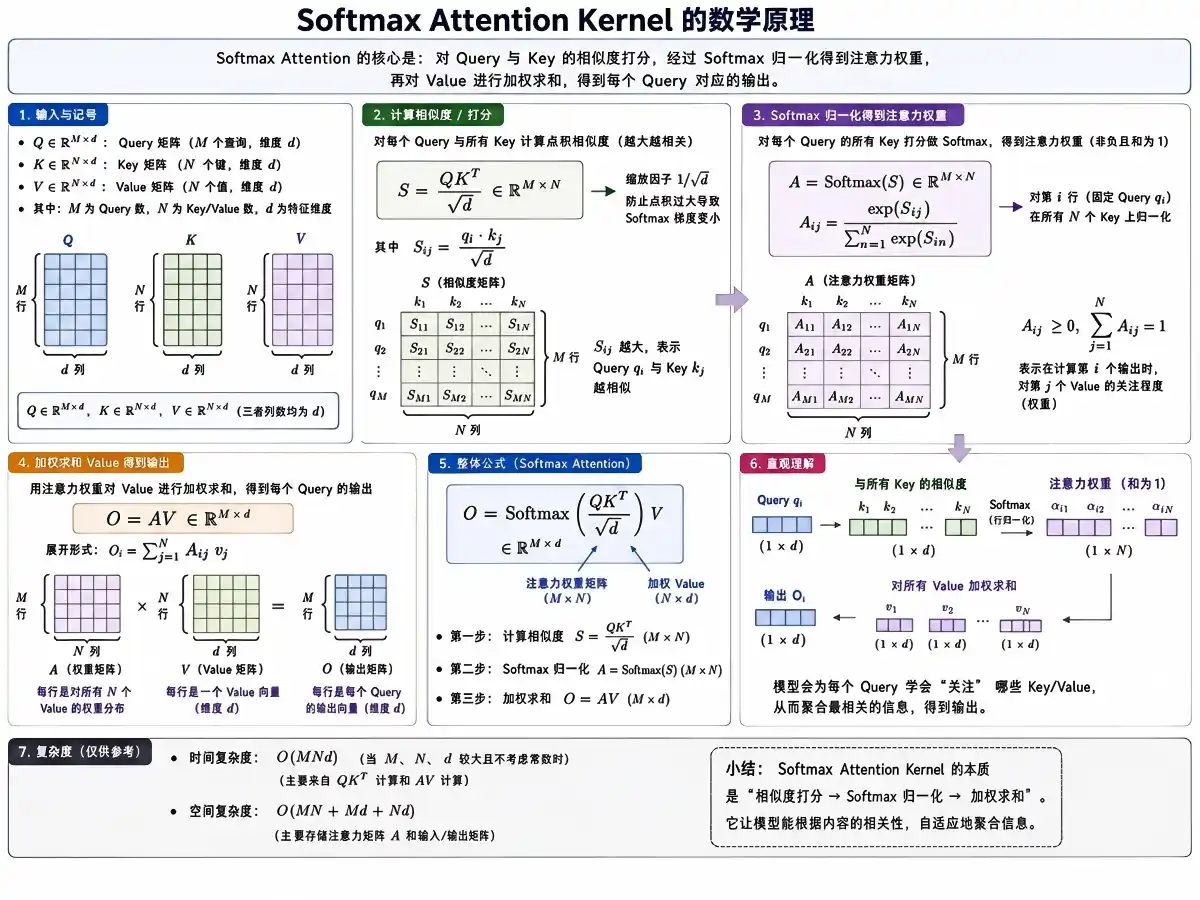
 图片由 GPT-5.6 Sol High 生成
实现思路·
标准的 scaled dot-product attention 可以写成:
O=softmax(dQKT)V
假设:
1
2
3
| Q: [M, d]
K: [N, d]
V: [N, d]
|
最直接的 PyTorch 实现是:
1
2
3
4
5
6
7
8
9
10
11
| import torch
import torch.nn.functional as F
def solve(
Q: torch.Tensor, K: torch.Tensor, V: torch.Tensor, output: torch.Tensor, M: int, N: int, d: int
):
scores = torch.matmul(Q, K.T) / (d ** 0.5)
attention = F.softmax(scores, dim=-1)
output.copy_(torch.matmul(attention, V))
|
这段代码的问题在于,Q @ K.T 会首先产生一个大小为 [M, N] 的 Attention Score 矩阵,softmax 之后仍然需要处理一个同样规模的矩阵。如果序列很长,这个中间结果会带来明显的显存占用和显存读写开销。
而本文实现的 Triton kernel 采用的是另一种计算顺序。先不完整计算 QK^T,而是让一个 Triton program 负责一个 Query,然后把 K 和 V 按 32 行一块依次读入:
1
2
3
4
5
6
| Q[i]
│
├── K[0:32] → score → softmax 更新 → V[0:32] → 累加
├── K[32:64] → score → softmax 更新 → V[32:64] → 累加
├── K[64:96] → score → softmax 更新 → V[64:96] → 累加
└── ...
|
最终,它只保留当前 Query、当前 K/V block,以及几个用于 softmax 和输出累积的中间变量,而不需要把完整的 Attention Probability 矩阵写回显存。
先从 kernel 的启动方式看:
1
2
3
| grid = (M,)
attention_kernel[grid](...)
|
这里的 grid = (M,) 意味着沿着第 0 个 grid 维度启动 M 个 Triton program,然后 kernel 内部通过 pid = tl.program_id(axis=0) 得到当前 program 的编号。所以整个 kernel 的任务划分可以表示为
1
2
3
4
5
| pid = 0 → 计算 output[0, :]
pid = 1 → 计算 output[1, :]
pid = 2 → 计算 output[2, :]
...
pid = M-1 → 计算 output[M-1, :]
|
也就是说,一个 program 对应一个 Query。接下来 Q + pid * stride_qm + offs_d * stride_qd 一次性构造当前 Query 这一整行的地址。等价于一次性构造:
1
2
3
4
| &Q[pid, 0]
&Q[pid, 1]
&Q[pid, 2]
...
|
然后通过 q = tl.load(q_ptrs, mask=mask_q, other=0.0) 把这一整块数据读出来。这里 mask_q = offs_d < d 是为了处理 BLOCK_SIZE_D 大于真实维度 d 的情况。外部代码中 BLOCK_SIZE_D = triton.next_power_of_2(d) 会把 d 向上补到最接近的 2 的次幂。后补的部分必须通过 mask 屏蔽,否则就会发生越界访问。
后面 K 和 V 的加载过程其实只是二维版本的同一个思路。
kernel 中的主循环是:
1
| for start_n in range(0, N, BLOCK_SIZE_N=32):
|
也就是说,一次只处理 32 个 Key 和 32 个 Value。
加载 K
1
2
3
4
5
6
| k = tl.load(
K +
offsets_n[:, None] * stride_kn +
offsets_d[None, :] * stride_kd,
mask=mask_k, other=0.0
)
|
这里同时使用了两个索引:offsets_n[:, None] 的 shape 是 [BLOCK_SIZE_N, 1],而 offsets_d[None, :] 的 shape 是 [1, BLOCK_SIZE_D],两者广播后就形成了一个二维地址网格:
1
| [BLOCK_SIZE_N, BLOCK_SIZE_D]
|
对应的数据可以想象成:
1
2
3
4
| K[n0, 0] K[n0, 1] ... K[n0, d-1]
K[n1, 0] K[n1, 1] ... K[n1, d-1]
K[n2, 0] K[n2, 1] ... K[n2, d-1]
...
|
于是 k 就是当前 32 个 Key 组成的二维 block。
然后
1
| qk = tl.sum(q[None, :] * k, axis=1)
|
本质上是在计算当前 Query 与这 32 个 Key 的点积。
q[None, :] 的 shape 是 [1, BLOCK_SIZE_D] 与 k.shape = [BLOCK_SIZE_N, BLOCK_SIZE_D],广播以后得到 [BLOCK_SIZE_N, BLOCK_SIZE_D],再沿 feature 维,也就是 axis=1 求和,最终得到 [BLOCK_SIZE_N]
其中每个元素分别是
q⋅k0,q⋅k1,…,q⋅k31
随后
1
2
| qk *= sm_scale
sm_scale = d ** -0.5
|
于是得到 Attention 中的
dqkT
需要注意的是,最后一个 K block 不一定刚好有 32 个合法 token。比如 N = 100,最后一轮索引是 96 到 127,其中只有 96 到 99 合法。
虽然 tl.load 时已经通过 mask 把越界的 K 填成了 0,但这还不够。如果 K 是 0,那么 q⋅0=0,而 softmax 中 score = 0 并不等于忽略这个位置,因为 e0=1
因此代码还需要
1
| qk = tl.where(offsets_n < N, qk, -float('inf'))
|
把非法位置的 score 设成负无穷。
普通 softmax 可以写成
pi=∑jexjexi
为了避免指数溢出,通常会先减去最大值
pi=∑jexj−mexi−m
其中
m=jmaxxj
如果一次能看到所有 score,这件事非常简单。问题在于,这个 kernel 每次只能看到 32 个 score。假设 N = 96,那么当前 Query 的 score 实际上是分三次出现的
1
| score[0:32] score[32:64] score[64:96]
|
第一块处理完时,根本不知道后面的 block 是否会出现更大的值。因此不能简单地对每个 block 独立做 softmax,再把结果拼起来。
代码初始化了三个核心状态
1
2
3
| m_i = -float("inf")
l_i = 0.0
acc = tl.zeros([BLOCK_SIZE_D], dtype=tl.float32)
|
它们分别表示
1
2
3
| m_i 当前为止见过的最大 score
l_i 当前 softmax 分母
acc 当前 softmax 加权 V 的分子
|
假设第一块 score 是
那么当前最大值变成 3。于是可以计算
[e1−3,e2−3,e3−3]
也就是
[e−2,e−1,1]
此时 softmax 的分母是
li=e−2+e−1+1
问题出现在下一块。假设第二块突然出现
新的最大值就从 3 变成了 10。第一块之前所有结果都是按照
ex−3
计算的。但为了继续和第二块合并,现在所有历史结果都必须重新转换到以 10 为最大值的表示方式
ex−10
而
ex−10=ex−3e3−10
所以不需要重新计算第一块的所有元素,只需要把之前累积的结果统一乘上:
e3−10
更一般地
α=emold−mnew
这就是代码 alpha = tl.exp(m_prev - m_i) 的由来。
因此 softmax denominator 可以在线更新
1
2
| p = tl.exp(qk - m_i)
l_i = l_i * alpha + tl.sum(p, axis=0)
|
实现了
1
| 旧 block 的贡献 × alpha + 当前 block 的贡献
|
这一步解决了“分块情况下如何计算完整 softmax”的问题。但 Attention 最终需要的不是 softmax probability 本身,而是
softmax(S)V
把公式展开就是
O=∑jesj−m∑jesj−mVj
所以只维护 denominator l_i 还不够,还要同步维护
j∑esj−mVj
当前 block 中 p[:, None] * v 会让当前 32 个 softmax 权重分别乘上对应的 Value:
1
2
3
4
| p0 * V0
p1 * V1
p2 * V2
...
|
随后:
1
| tl.sum(p[:, None] * v, axis=0)
|
得到:
j∑pjVj
循环结束后
acc=j∑esj−mVj
同时
li=j∑esj−m
因此
就得到
O=∑jesj−m∑jesj−mVj
也就是标准的
O=softmax(S)V
1
2
3
4
5
6
7
8
9
10
11
12
13
14
15
16
17
18
19
20
21
22
23
24
| for i in parallel(range(M)):
q = Q[i]
running_max = -inf
denominator = 0
numerator = zeros(d)
for start in range(0, N, 32):
k = K[start:start + 32]
v = V[start:start + 32]
scores = q @ k.T / sqrt(d)
new_max = max(running_max, scores.max(),)
alpha = exp(running_max - new_max)
weights = exp(scores - new_max)
denominator = (denominator * alpha + weights.sum())
numerator = (
numerator * alpha
+ (weights[:, None] * v).sum(dim=0)
)
running_max = new_max
output[i] = numerator / denominator
|
- 完整 Triton Attention Kernel 实现
1
2
3
4
5
6
7
8
9
10
11
12
13
14
15
16
17
18
19
20
21
22
23
24
25
26
27
28
29
30
31
32
33
34
35
36
37
38
39
40
41
42
43
44
45
46
47
48
49
50
51
52
53
54
55
56
57
58
59
60
61
62
63
64
65
66
67
68
69
70
71
72
73
74
75
76
| import torch
import triton
import triton.language as tl
@triton.jit
def attention_kernel(
Q, K, V, output,
stride_qm, stride_qd,
stride_kn, stride_kd,
stride_vn, stride_vd,
stride_om, stride_od,
M, N, d,
sm_scale,
BLOCK_SIZE_N: tl.constexpr,
BLOCK_SIZE_D: tl.constexpr,
):
Q = Q.to(tl.pointer_type(tl.float32))
K = K.to(tl.pointer_type(tl.float32))
V = V.to(tl.pointer_type(tl.float32))
pid = tl.program_id(0)
offsets_d = tl.arange(0, BLOCK_SIZE_D)
mask_q = offsets_d < d
q = tl.load(Q + pid * stride_qm + offsets_d * stride_qd, mask=mask_q, other=0.0)
m_i = -float('inf')
l_i = 0.0
acc = tl.zeros([BLOCK_SIZE_D], dtype=tl.float32)
for start_n in range(0, N, BLOCK_SIZE_N):
offsets_n = start_n + tl.arange(0, BLOCK_SIZE_N)
mask_k = (offsets_n[:, None] < N) & (offsets_d[None, :] < d)
k = tl.load(K + offsets_n[:, None] * stride_kn + offsets_d[None, :] * stride_kd,
mask=mask_k, other=0.0)
qk = tl.sum(q[None, :] * k, axis=1)
qk *= sm_scale
qk = tl.where(offsets_n < N, qk, -float('inf'))
m_prev = m_i
block_max = tl.max(qk, axis=0)
m_i = tl.maximum(m_prev, block_max)
alpha = tl.exp(m_prev - m_i)
p = tl.exp(qk - m_i)
l_i = l_i * alpha + tl.sum(p, axis=0)
mask_v = (offsets_n[:, None] < N) & (offsets_d[None, :] < d)
v = tl.load(V + offsets_n[:, None] * stride_vn + offsets_d[None, :] * stride_vd,
mask=mask_v, other=0.0)
acc = acc * alpha + tl.sum(p[:, None] * v, axis=0)
acc = acc / l_i
tl.store(output + pid * stride_om + offsets_d * stride_od, acc, mask=mask_q)
def solve(
Q: torch.Tensor, K: torch.Tensor, V: torch.Tensor, output: torch.Tensor, M: int, N: int, d: int
):
sm_scale = d ** -0.5
grid = (M,)
BLOCK_SIZE_N = 32
BLOCK_SIZE_D = triton.next_power_of_2(d)
attention_kernel[grid](
Q, K, V, output,
Q.stride(0), Q.stride(1),
K.stride(0), K.stride(1),
V.stride(0), V.stride(1),
output.stride(0), output.stride(1),
M, N, d,
sm_scale,
BLOCK_SIZE_N=32,
BLOCK_SIZE_D=triton.next_power_of_2(d),
num_warps=4,
num_stages=2
)
|
讨论
评论